Enterprise BOM Configurator

Self-service network design. Engineering-verified specs.

When enterprise customers need to design a network, they shouldn’t have to wait days while engineering researches compatible products. I built a self-service configurator that guides customers through 10 logical steps—from access points to UPS backup—and delivers a quote-ready bill of materials in minutes. The tool codifies engineering expertise into reusable infrastructure.

THE PROBLEM

At WAV, the engineering team had a recurring frustration: they spent most of their day answering the same question from salespeople, over and over.

“Find me a 12-port switch with PoE, 10GbE support, and SFP capability.”

“What RUCKUS access points work in outdoor environments with high-density coverage?”

“Do these cables work with this patch panel?”

Each request sent an engineer into the datasheets. Two to four hours of cross-referencing specs across four hardware brands—Ubiquiti, Cambium, RUCKUS, and TP-Link—digging through compatibility matrices, verifying port counts, and power requirements. The customer waited. The salesperson waited. The sales cycle is extended by days.

Salespeople had a different problem. They don’t have the technical expertise to design enterprise networks, so they ask the engineering department. But they also don’t think to ask about everything—they remember to ask about access points, then forget about switches, cables, keystones, patch panels, UPS backup. Customers buy incomplete solutions. Support gets called. Follow-up sales drag on.

The real bottleneck:

Critical knowledge was trapped in datasheets and one team’s heads. Every question required the same research, repeated.

THE SOLUTION

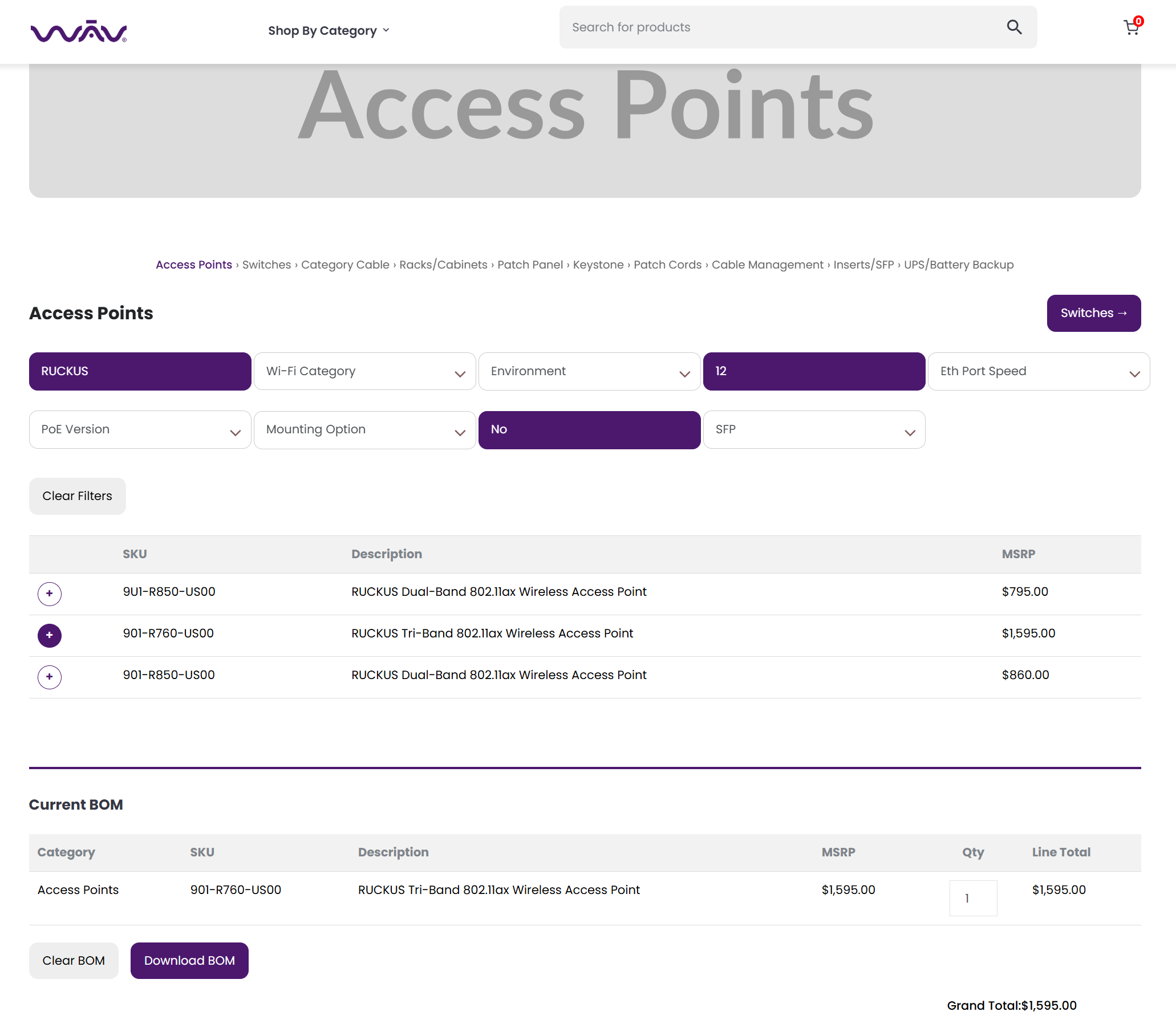
I took an existing spreadsheet—a complete compatibility matrix that the engineering team had already vetted across their entire product line—and converted it into a guided, self-service configurator.

Customers walk through 10 logical categories that build a complete enterprise network. At each step, smart filters narrow thousands of SKUs to the ones that are actually relevant by vendor, Wi-Fi standard, environment, streams, PoE version, and mounting option. As they filter, only compatible products appear. Add items to the BOM with the + button. The Current BOM is built in real time with SKU, description, MSRP, quantity, and line total. When complete, download as CSV—quote-ready, accurate, complete.

THE 10-STEP NETWORK DESIGN

Most salespeople think about networks in silos: “how many access points?” The configurator forces the right sequence, every component a complete enterprise network requires, in the order an engineer would build it.

  1. Access Points: Wi-Fi infrastructure
  2. Switches: Core network fabric
  3. Category Cable: Copper backbone
  4. Racks / Cabinets: Equipment housing
  5. Patch Panels: Cable termination
  6. Keystones: Connection points
  7. Patch Cords: Equipment-to-panel runs
  8. Cable Management: Organization
  9. SFP Modules: Fiber/long-distance optics
  10. UPS / Battery Backup: Power redundancy
WAV BOM Configurator

THE BUSINESS IMPACT

1

HIGHER TRANSACTION VALUE

Salespeople typically sell access points and maybe switches. The configurator walks customers through 10 categories, so a single quote now includes APs, switches, cables, patch panels, keystones, UPS backup, everything. Average bill-of-materials size goes up. Revenue per transaction goes up.

2

SAME-DAY TURNAROUND

Without the tool, a customer question went to engineering, took 2-4 hours of research, and reached the customer in 3+ days. With the tool, a salesperson answers in minutes. The sales cycle accelerates dramatically.

3

ENGINEERING FREED

The engineering team is no longer answering “find me a switch with X, Y, Z” 50 times a day. They’re freed to vet new products, test additions to the line card, and expand the portfolio, work only they can do.

THE THINKING BEHIND IT

The bottleneck wasn’t that customers were uninformed or that salespeople were lazy. The bottleneck was that specialized expertise was trapped answering repetitive questions instead of doing specialized work.

By codifying engineering’s knowledge into a guided decision tree, I freed the team to do more of the work only they could do. The configurator isn’t impressive because it’s a tool, it’s impressive because it solves a real operational constraint. Every business has knowledge trapped in someone’s head. The win is figuring out which knowledge can be codified and where the leverage is highest.

THE OUTCOME

I shipped this in late 2025. The engineering team told me it changed how they work. It solved a real problem and changed operations.

Try the Live Tool →